Is Turning the Thermostat Down One Degree Really Worth It? The Actual Numbers
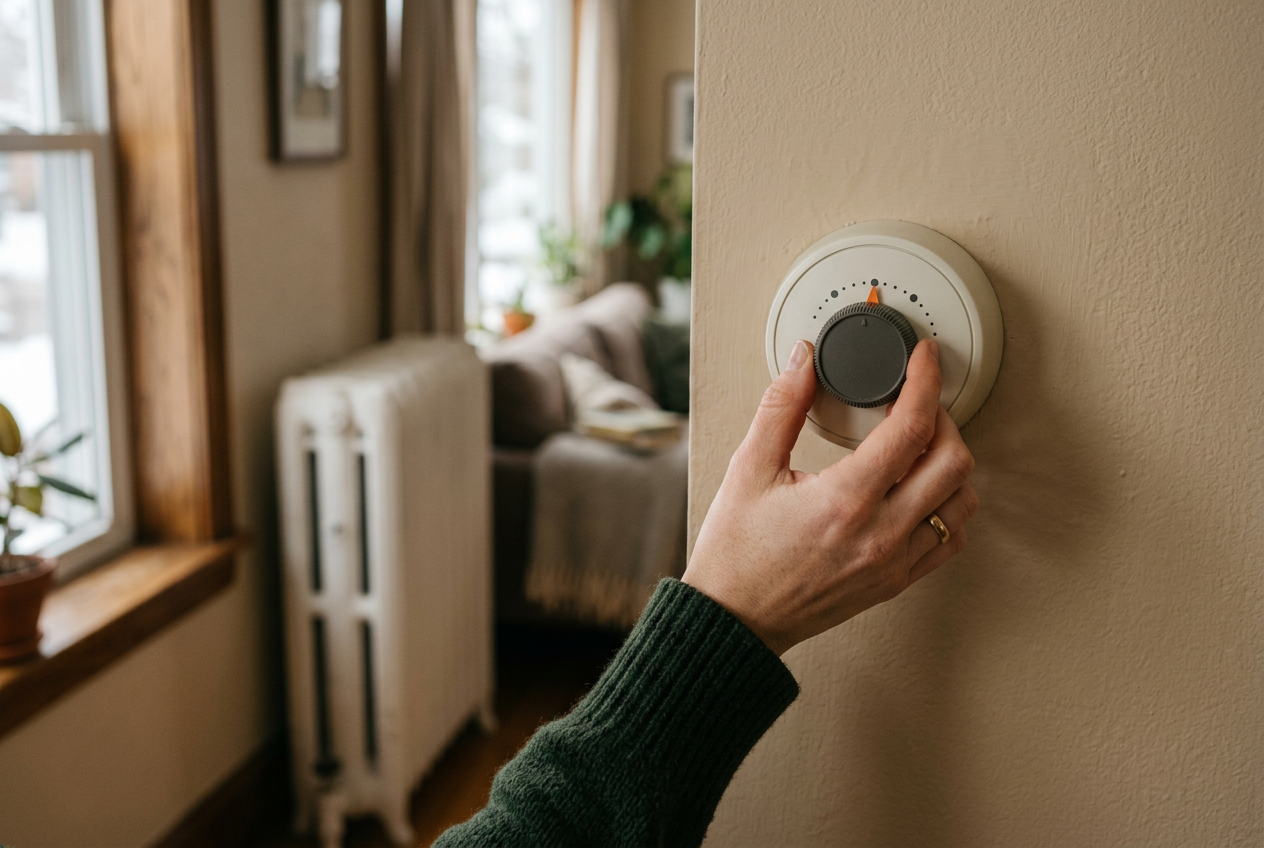
Every autumn the same advice appears: turn your thermostat down one degree and save a meaningful share of your heating bill. It is repeated so often that it has stopped meaning anything. So what does one degree actually do?
The short answer is that it is real, it is modest, and there are three or four other settings in the average home that save considerably more for the same effort.
Where the figure comes from
The commonly quoted range is that each degree Celsius of reduction cuts heating energy by somewhere between three and ten percent, with most European guidance landing near seven to ten percent per degree Celsius, and US guidance often expressed as roughly one to three percent per degree Fahrenheit over an eight-hour period.
The spread is that wide because the saving is not a property of thermostats. It is a property of your house.
Heat loss is driven by the difference between inside and outside temperature. Drop the inside by one degree and you reduce that difference — but by a different proportion depending on where you live. In a mild British winter, with an average outdoor temperature around 6°C and an indoor target of 21°C, one degree is one fifteenth of the gap, roughly seven percent. In an Alberta January at -20°C, one degree off a 21°C target is one forty-first of the gap, around two percent.
So the same advice is worth three times more in Bristol than in Winnipeg.
What that means in money
Take a UK household spending £900 a year on gas heating. Seven percent is about £63 a year, or roughly £5 a month across the heating season. Real, but not transformative.
A US household spending $1,200 a year on heating and dropping the thermostat from 70°F to 69°F might save $25 to $40. A Canadian household with higher consumption and a colder climate saves a similar dollar figure on a larger bill.
Sustained setbacks do considerably better than a one-degree trim, because the saving scales with both the size of the drop and its duration. Turning the heat down by 7 to 8°F for eight hours while everyone is asleep or out is the setting most commonly cited as worth around ten percent off annual heating costs, and it costs nothing to program.
Four changes that beat it
Set the boiler flow temperature correctly. This is the biggest free win in most UK and European homes, and it is almost never mentioned. A condensing combi boiler only reaches its rated efficiency when the water returning to it is cool enough for the flue gases to condense. Most are installed with the radiator flow set to 75 or 80°C, which prevents that. Turning the radiator flow dial down to 55 to 60°C — not the hot water dial — typically improves efficiency by several percent with no loss of comfort, though the house will warm up more slowly. It costs nothing and takes ten seconds.
Zone the house with radiator valves. Rooms that are unused do not need heating to living-room temperature. Thermostatic radiator valves set low in spare rooms, with the doors closed, reduce the volume you are heating. Leave them at the frost setting rather than fully off to protect pipework.
Fix the schedule, not just the setpoint. A great many homes heat an empty house every weekday. Getting the timer to match when people are actually in is usually worth more than any temperature change, and a smart thermostat with presence detection does it automatically for $100 to $250.
Stop the heat leaving. Draught-proofing a leaky house, insulating a hot water cylinder, and topping loft insulation up to current depth all reduce demand permanently rather than trading comfort for money.
The honest caveat
There is a floor below which this stops being a good trade. Health guidance in the UK suggests a minimum of around 18°C for living areas, and higher for older people, very young children and anyone with a respiratory or circulatory condition.
Cold homes also cost money in other ways. Below about 16°C, condensation on cold surfaces rises sharply, and persistent damp leads to mould, which is expensive to remediate and bad for the fabric of the building.
So the sensible approach is not to chase the lowest tolerable number. It is to find the temperature where the house is comfortable in a jumper, set the schedule honestly, get the boiler settings right, and spend the effort on the fabric of the building instead. One degree is worth having. It is just not the biggest thing in the room.
What temperature should I actually set my thermostat to?
Most guidance lands at 68°F or 20°C for occupied living areas during the day, with bedrooms a few degrees cooler and a setback of 7 to 8°F overnight and when the house is empty. Treat that as a starting point and adjust once, not repeatedly — constant fiddling wastes more than it saves.
Is it cheaper to leave the heating on low all day?
For almost all homes, no. A house loses heat continuously whenever it is warmer than outside, so keeping it warm around the clock loses more total energy than letting it cool and reheating. The exception is a very well insulated home with a heat pump, where a steadier low-temperature output is often more efficient than sharp cycling.
Do smart thermostats really pay for themselves?
Usually, but over years rather than months. The savings come from scheduling, zoning and not heating an empty house, so the payback is largest in households with irregular hours and smallest in homes where someone is in all day with an already accurate timer. If your current schedule is wrong, a $15 seven-day programmer captures much of the same benefit.