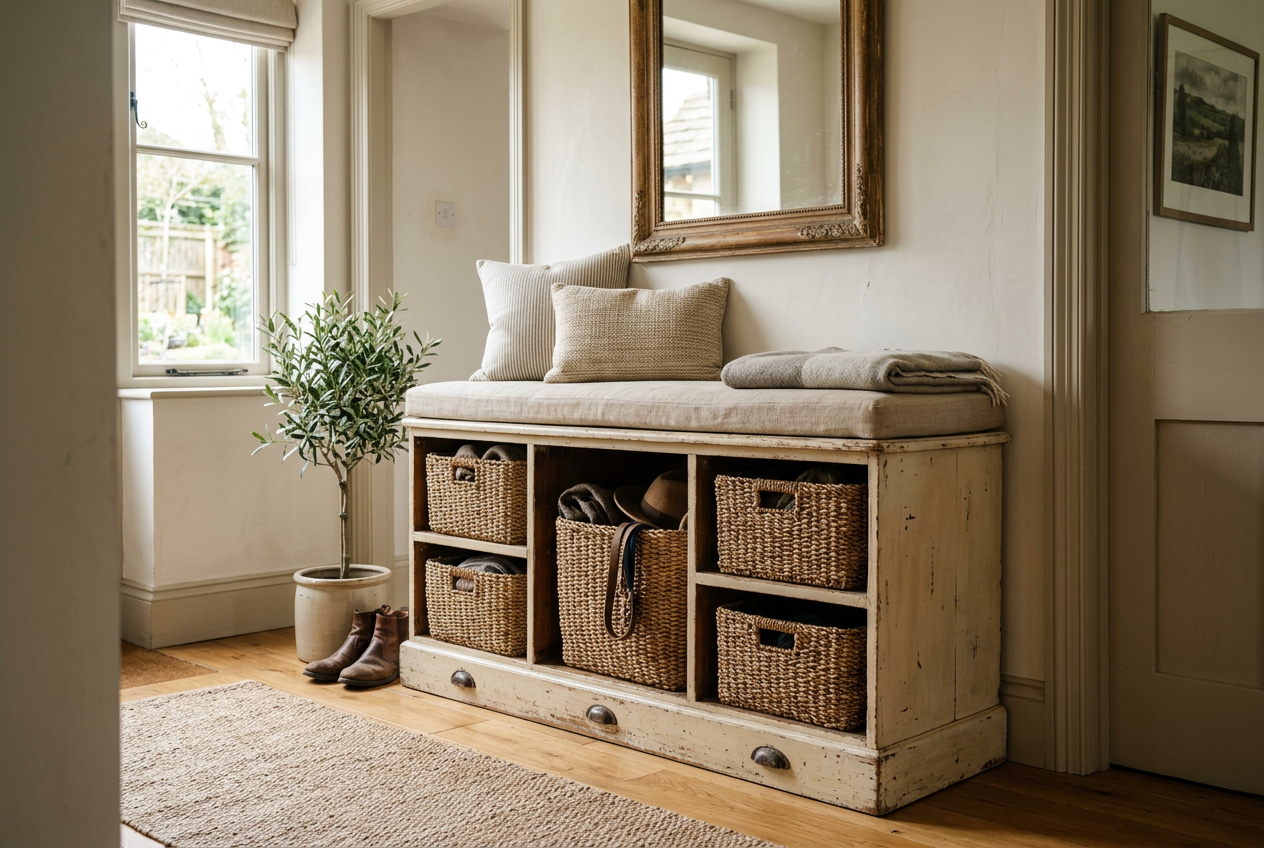
6. Broken furniture as a hallway bench, a planter or a desk
The biggest items are the most satisfying to save and the most likely to end up as landfill, because a chest of drawers with two broken runners feels beyond help and is expensive to dispose of.
Start by assessing honestly. Solid wood, plywood and good-quality veneer are worth the effort. Particleboard that has swollen with water is not — it never recovers structurally, and no amount of paint fixes a wet-crumbled carcass. Check the joints: a piece that racks when you push it sideways needs the joints reglued and clamped before anything cosmetic happens, and that is an easy evening’s work with wood glue and a couple of ratchet straps.
A chest of drawers with failed runners becomes a hallway bench: remove the drawers, fit a cushion or a cut board and foam on top, and use the openings for baskets holding shoes, gloves and dog gear. This is a genuinely useful piece of hall furniture that costs $200 or more new.
A drawer on its own, with castors screwed to the base, becomes under-bed storage. Two drawers side by side on a wall become shadow-box shelving. A deep drawer lined with plastic sheet and drilled for drainage becomes a herb planter for a patio.
A table with a wobbly leg is usually fixable in twenty minutes: tighten or replace the leg bolts, and glue any loose dowels. A tabletop with a broken base becomes a desk on two trestles or a pair of small cabinets. A solid door on trestles is the classic version and is still the cheapest large desk you can get.
For the finish, sand back to sound material, prime with a decent adhesion primer — this is the step that determines whether the paint survives — and use a hard-wearing satin furniture paint. Two thin coats, sanding lightly between them. New handles for $20 complete the transformation.
If a piece is genuinely beyond saving, break the value out before it goes: handles, hinges, castors, drawer runners, knobs and solid timber are all reusable, and the local scrap wood is often taken gratefully by a men’s shed, a community workshop or a school. Listing the whole piece free on a local marketplace with an honest description of the fault nearly always finds someone with the time and skill you do not have — which is the last and easiest repurposing of all.